Home / Itinerary

Trip Details, Dates, Prices, etc.

Menu
16 Days Sichuan Spring Birding Tour
  
Located in southwestern China along the upper reaches of the Yangtze River, Sichuan Province spans 486,000 square kilometers and is home to over 90 million people. Geographically, the province is divided into three main regions: the Sichuan Basin in the central and eastern areas, the Qinghai-Tibet Plateau in the west and north, and the southern hilly regions. The western part of Sichuan features dramatic landscapes shaped by the Qinghai-Tibet Plateau and the Hengduan Mountain Ranges, while the Yunnan-Guizhou Plateau lies to the south and the Qinling-Daba Mountain Ranges to the north.
      
Sichuan’s diverse topography and climate support an exceptional variety of flora and fauna, including numerous rare and endemic species. Over 750 bird species have been recorded in the province. Often referred to as the “Kingdom of Pheasants”, Sichuan hosts 23 species of Galliformes, roughly 35% of China’s total, with 10 of these being endemic.
      
This 16-day itinerary, scheduled in Spring, takes advantage of the season’s unique benefits: mammals are more active and easier to observe, and some of the high-elevation bird species move to lower altitudes, providing better chances for observation. The trip covers a wide range of habitats, visiting celebrated sites such as Yibin, Wawu Mountain, Yajiang, Jingtang, Miansi, and Tangjiahe National Nature Reserve.
      
This journey highlights China’s endemic and range-restricted species in the spring season, offering excellent opportunities to observe rare and localized birds—not only elusive pheasants, parrotbills, and rosefinches, but also remarkable mammals such as Red Panda, Golden Snub-nosed Monkey, Hog Badger, Takin, Tibetan Macaque, Reeves’ Muntjac, Chinese Goral, Tufted Deer, and Sambar. In addition to wildlife, travelers will enjoy breathtaking landscapes and the rich cultural heritage of Sichuan’s ethnic minority communities.


Tour Info Sheet

Highlight BirdsChinese Monal, Sichuan Partridge, Chinese Bamboo Partridge, Lady Amherst's Pheasant, Golden Pheasant, Buff-throated Monal-Partridge, Silver Pheasant, Blood Pheasant, White Eared-Pheasant, Temminck's Tragopan, Tawny Fish Owl, Himalayan Owl, Emei Shan Liocichla,  Red-billed Leiothrix, Ashy-throated Parrotbill, Gray-hooded Parrotbill, Fulvous Parrotbill, Golden Parrotbill, Great Parrotbill, Three-toed Parrotbill, Brown Parrotbill, Golden-breasted Fulvetta, White-browed Bush Robin, Golden Bush Robin, Buffy Laughingthrush, Red-winged Laughingthruhrush, Black-faced Laughingthrush, Elliot's Laughingthrush, Barred Laughingthrush, Chinese Babax, Red-billed Blue Magpie, Hodgson's Treecreeper, Vinaceous Rosefinch, Sharpe's Rosefinch, Dark-breasted Rosefinch, Chinese White-browed Rosefinch, etc.
Number of Species to Expected130-180
Ease of Birdingmostly easy birding with a few tricky species
Highlight MammalsGolden Snub-nosed Monkey, Takin, Tibetan Macaque, Reeves’ Montjac, Chinese Goral
Other AttractionsTibetan culture, wild panda habitat, delicate food
Photography opportunitiesBirding focused but with very good photography chances
Habitats Coveredsubtropical forests, woodlands, snow mountains
Expected Climatemostly comfortable, windy and cold on snow mountains, rain is possible
Physical Requirementsmostly easy, demanding but optional on certain parts
Accommodationcomfortable
Transportation19-seat van


Dates & Prices

DatesBooking StatusPriceSingle SupplementGroup SizeGuide
April 23 – May 8, 2027Open for Booking4, 598USD/pax450USD/pax8Local Guide
Slide the sheet to left to see the full sheet if you are viewing on your phone or tablet.
 
The cost includes the following:
1. Services of an experienced English-speaking bird guide from day 2 through day 16.
2. Accommodation from the first night to the last night, at the quality of 3- to 4-star hotels in cities and nice guesthouses in remote areas.
3. Private transportation throughout the trip, including airport pick-up.
4. Meals at well-reviewed local restaurants, from dinner on the first day through dinner on the final day. Picnic breakfasts and lunches will be provided when necessary.
5. Entrance fees for all sites listed in the itinerary, including birding hides and shuttle buses.
6. Bottled water and snacks provided throughout the trip.
7. China domestic travel insurance coverage.
8. Full logistical support throughout the journey..


The cost does not include the following:
1. Soft drinks and alcoholic beverages during meals.
2. Additional costs arising from itinerary changes made by the client or from factors beyond AlpineBirding’s control, such as natural disasters or changes in government policy.
3. Discretionary tips for local guides and drivers.
4. Personal expenses, including laundry services.
5. Airfare to the trip starting point and from the trip ending point.
6. Banking and transaction fees charged by banks or third-party companies during payment to AlpineBirding’s accounts.
7. Any activities or services not listed in the itinerary.

Itinerary

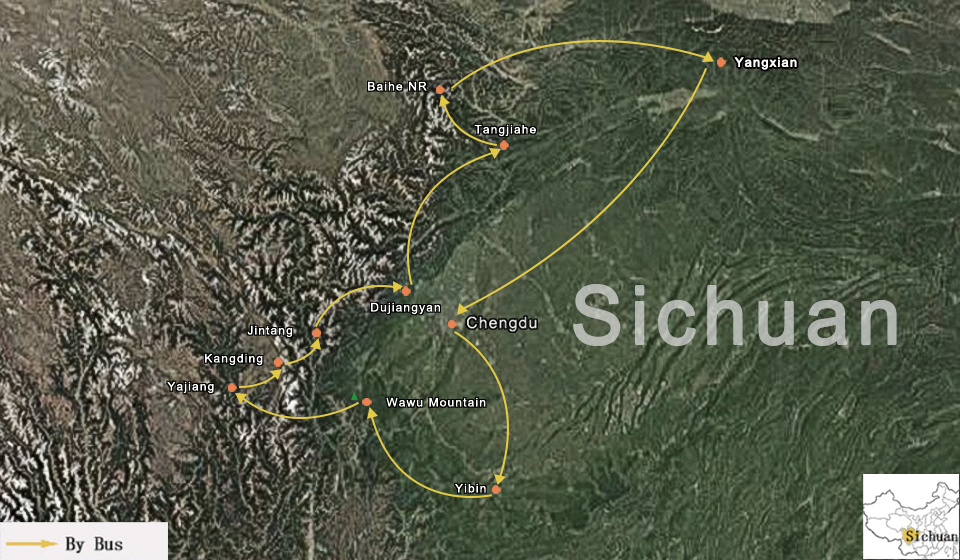
Tour Map

地图(川西)cl002.png
Day 1: Arrive in Chengdu (~500m)
Meet your driver at either Chengdu Shuangliu Airport or Tianfu International Airport, then drive about 1 hour to the hotel in the city.
 
Day 2: Chengdu to Yibin (4hrs, ~500m)
After breakfast, we have a short visit to the Chengdu Botanical Garden. Known as one of the best urban birding spots in the city, the garden boasts a rich diversity of flora and high forest coverage. It offers excellent opportunities to observe a variety of urban and resident bird species, such as the Light-vented Bulbul, White-browed Laughingthrush, Red-billed Leiothrix, Swinhoe's White-eye, Chinese Blackbird, Chinese Grosbeak, Collared Finchbill, Long-tailed Shrike, and Fork-tailed Sunbird. Following the visit, we drive to Yibin.
 
Day 3: Yibin (500-1600m)
We spend the full day at several birding hides in Yibin. Tanshi Village, located in a beautiful low-altitude forest, has become a prime birding destination in recent years. With support from the local government, residents build multiple well-maintained hides, providing food and water to attract birds for birders and photographers. These hides serve as a sanctuary for several rare and elusive species that are difficult to observe in the wild, including Lady Amherst's Pheasant, Temminck's Tragopan, Sichuan Partridge, Silver Pheasant, Emei Shan Liocichla, Buffy Laughingthrush, Golden Parrotbill, and Sulphur-breasted Warbler. Other fascinating species we may encounter include Bay Woodpecker, Chinese Hwamei, Black-streaked Scimitar Babbler, Red-winged Laughingthrush, Sichuan Bush Warbler, Golden-breasted Fulvetta, Grey-headed Parrotbill, Ashy-throated Parrotbill, and more.
 
Day 4: Yibin to Wawu Mountain (4hrs, 500-1900m)
This morning, we have a chance to try for some key species we may still need to find before driving to Wawu Mountain.
 
Day 5: Wawu Mountain (1900-2600m)
Wawu Mountain is not only a popular tourist destination but also an unmissable birding hotspot in China, renowned for its incredible diversity of parrotbills, fulvettas, laughingthrushes, and warblers. In addition to its rich birdlife, Wawu is one of the best places to search for Red Pandas in the wild. We spend a full day exploring different elevations of the mountain in search of target species such as Grey-hooded Parrotbill, Three-toed Parrotbill, Brown Parrotbill, Great Parrotbill, Fulvous Parrotbill, Golden Parrotbill, Vinaceous Rosefinch, Sichuan Leaf Warbler, Buff-barred Warbler, Greenish Warbler, Large-billed Leaf Warbler, Buff-throated Warbler, Claudia's Leaf Warbler, Kloss's Leaf Warbler, Asian Lesser Cuckoo, Himalayan Owl, Alström's Warbler, Bianchi's Warbler, Martens's Warbler, Golden Bush Robin, White-bellied Redstart, Spotted Bush Warbler, Darjeeling Woodpecker, Necklaced Woodpecker, Black-headed Sibia, White-browed Bush Robin, and Yellow-browed Tit. Other fascinating species we may encounter include Temminck's Tragopan, Ferruginous Flycatcher, Dark-sided Flycatcher, Sichuan Thrush, Eurasian Three-toed Woodpecker, Emei Shan Liocichla, Rufous-faced Warbler, Golden-breasted Fulvetta, Mrs. Gould's Sunbird, Himalayan Shortwing, Hodgson's Treecreeper, Rufous-bellied Niltava, Dusky Fulvetta and more.
 
Day 6: Wawu Mountain to Yajiang (6.5hrs, 1900-2600m)
This morning, we have a final chance to search for any key species we may still be missing before embarking on the relatively long drive to Yajiang.
 
Day 7: Yajiang to Kangding (4hrs, 3700-2500m)
We drive to a nearby mountain in the early morning, where a Tibetan monastery sits atop the peak. Buddhism has long been an integral part of local Tibetan life, fostering a deep respect for all living beings and encouraging people to treat wildlife as equals to humans. This belief has transformed the area into a paradise for wildlife and an ideal destination for birding, as the birds here are unafraid of human presence. We have excellent opportunities to spot species such as Buff-throated Monal-Partridge, Blood Pheasant, White Eared-Pheasant, Yunnan Nuthatch, Black-browed Tit, Rufous-vented Tit, Grey-crested Tit, Chinese White-browed Rosefinch, Pink-rumped Rosefinch, and White-backed Thrush. After exploring Yajiang, we continue our journey to Kangding.
 
Day 8: Kangding to Jintang (4hrs, 2500-3500m)
We spend the morning in a hide in Kangding, photographing species such as Lady Amherst’s Pheasant, Barred Laughingthrush, Chinese Babax, White-collared Yuhina, Black-browed Tit, and Streak-breasted Scimitar Babbler. Afterwards, we continue our drive to Jintang.
 
Day 9: Jintang (3500-4800m)
We spend the day birding at the monal site for the Chinese Monal, White Eared-Pheasant, Blood Pheasant, etc.
 
Day 10: Jintang to Dujiangyan (4hrs, 3800-700m)
In the morning, we visit the Chinese Monal site and look for target species we may still need. Afterward, we drive to Dujiangyan and explore a nearby mountain area in search of Chinese Bamboo Partridge, Black Bulbul, Collared Finchbill, Fire-breasted Flowerpecker, and other species.
 
Day 11: Dujiangyan to Tangjiahe Nature Reserve(4.5hrs, 700-1500m)
This morning, we visit a nearby panda base, which is itself a beautifully designed garden, featuring elegant landscaping and a rich collection of endemic plant species. Here, we can enjoy views of both Giant pandas and Red Pandas, while also having opportunities to observe additional low-elevation bird species. After the visit, we begin our journey to Tangjiahe Nature Reserve. En route, we stop at a small ancient village and its local market to stretch our legs and admire the traditional architecture. Upon entering the reserve, we start searching for wildlife.
 
Day 12: Tangjiahe (~1500m)
Tangjiahe is one of China’s premier sites for spotting both mammals and birds. We primarily explore the area during the early morning and late afternoon, when wildlife activity peaks. Our main target species include Slaty Bunting, Tawny Fish Owl, Kloss’s Leaf Warbler, Claudia’s Leaf Warbler, Alström's Warbler, Crested Kingfisher, Yellow-throated Bunting, and Yellow-bellied Tit. 
 
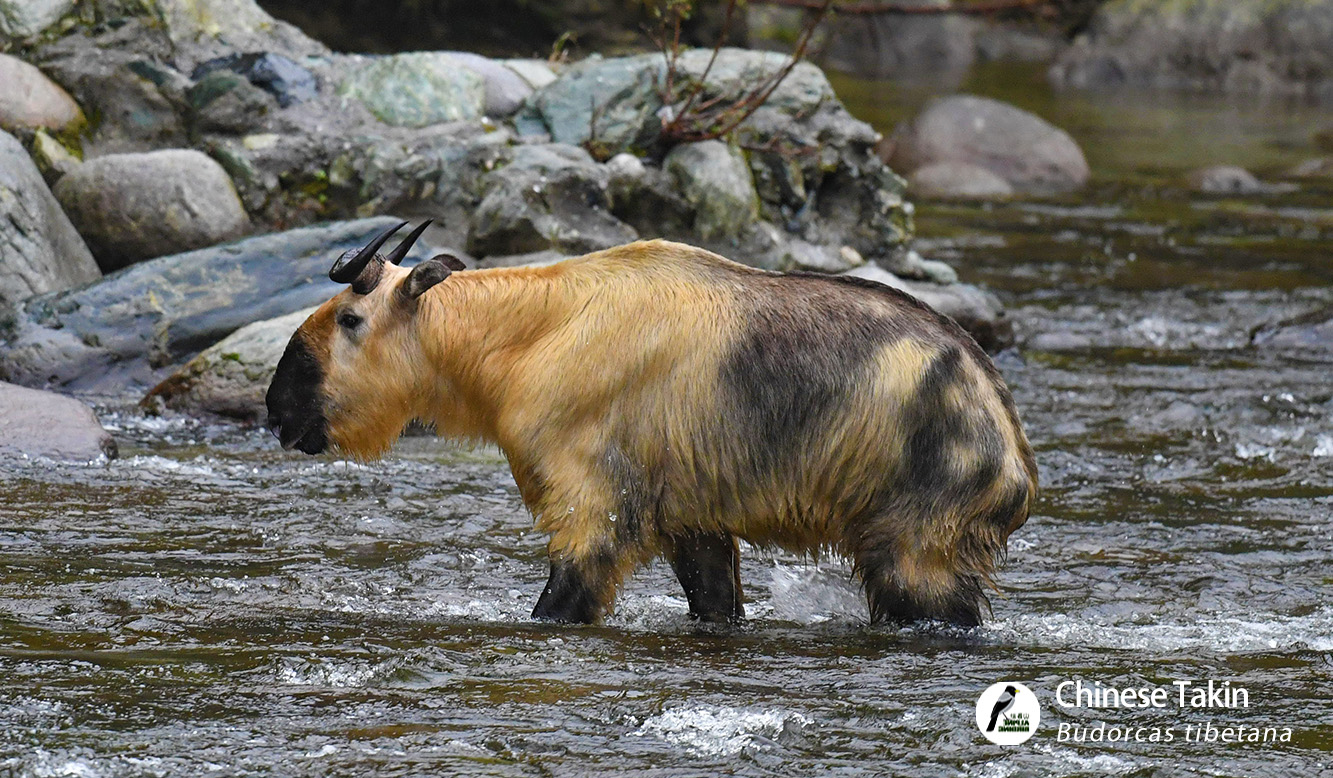
Mammal sightings here are equally rewarding. Visitors often see a Takin crossing the road right in front of them. Tibetan Macaques and Reeves’ Muntjac frequently wander along riversides, while the Chinese Goral usually appears on cliffs. Species such as Tufted Deer and Asiatic Black Bear are more secretive and require greater effort and some luck to observe.
 
Day 13: Tangjiahe to Baihe (3hrs,1500-1200m)
We spend most of the day exploring Tangjiahe before driving to Baihe in the afternoon.
 
Day 14: Baihe to Yangxian (5hrs,1900-1000m)
Leave early to look for the Golden Snub-nosed Monkey. After our visit, we drive to Guangyuan Railway Station and board a high-speed train to Yangxian. Upon arrival, we transfer to our hotel and check in for the night.
 
Day 15: Yangxian (~1000m)
Yangxian is located south of the Qinling Mountains, a major biogeographical boundary between northern and southern China. This unique location supports a fascinating mix of bird species and is best known as the last refuge of the endangered Crested Ibis. Once thought to be extinct, the species was rediscovered here in the 1980s when just seven individuals were found. Thanks to decades of dedicated conservation efforts, the population has gradually recovered to more than 3,000 birds. 
 
In the morning, we explore Yangxian and search for some of the region’s specialty birds, including Crested Ibis, Collared Crow, Yellow-throated Bunting, Cattle Egret, Russet Sparrow, and other species. In the afternoon, we visit the Golden Pheasant hide for another opportunity to photograph this spectacular bird.
 
Day 16: Yangxian to Chengdu (1000-500m)
We continue our exploration of Yangxian in the morning, looking for any target species we may still need before transferring to the railway station for a high-speed train back to Chengdu. 
 
Upon arrival in Chengdu, we transfer to an airport hotel conveniently located inside the terminal, making departure the following day easy and stress-free. This marks the end of AlpineBirding's services.
 

Guide(s)

We will arrange one of our best local guides for this trip who has rich experience of guiding tours in this region. The following are some of our best local guides in and around this area.
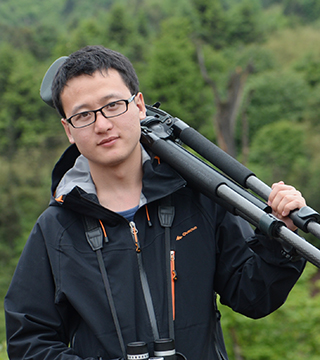
20200709052143131.jpgShay Xie

Shay is among the first group of professional bird guides with the academic background of ornithology. He spent his childhood in a small county of Chongqing municipality where is the eastern edge of Daba mountains. Being brought up in a beautiful natural environment and surrounded by beautiful nature creatures, Shay has developed a strong interest in nature and birds since he was a small kid. Following the call from his inner heart, he chose to study ecology as his major when he was admitted to Sichuan University. The campus of Sichuan University itself is one of the most famous birding sites in Sichuan and he spent most of his afterschool time birding there. Since that time he started working as a part-time bird guide. After four years of academic study in the university and birding on the campus, he recorded many rare bird species including Blackthroat and Firethroat in Chengdu. Before he joined AlpineBirding, he worked as a professional freelancer bird guide and often participated in some special surveys on birds and mammals in southwestern China. These experiences form fields that have greatly enriched his knowledge of birds and nature. By now, he has successfully guided many avid birders from different countries including Norway, Britain, US, Russia, Sweden, Thailand, Israel, etc. Now working as a full-time bird guide in AlpineBirding, Shay will do his best to create your best birding experiences in China with his experiences, knowledge and passion. 


guide.png

Alice Liu

Alice is an experienced bird and wildlife guide specializing in Southwestern China, particularly Yunnan Province. Her passion for nature began at a young age, sparked by a deep interest in mammals and mushrooms. In 2008, she expanded her fascination to the world of birds and has been an avid birdwacher ever since.

Home Tours Brochure Email info@alpinebirding.com More

Questions? Call +86 19934522663(WhatsAPP)

close
Top Call +86 19934522663(WhatsAPP) E-mail info@alpinebirding.com